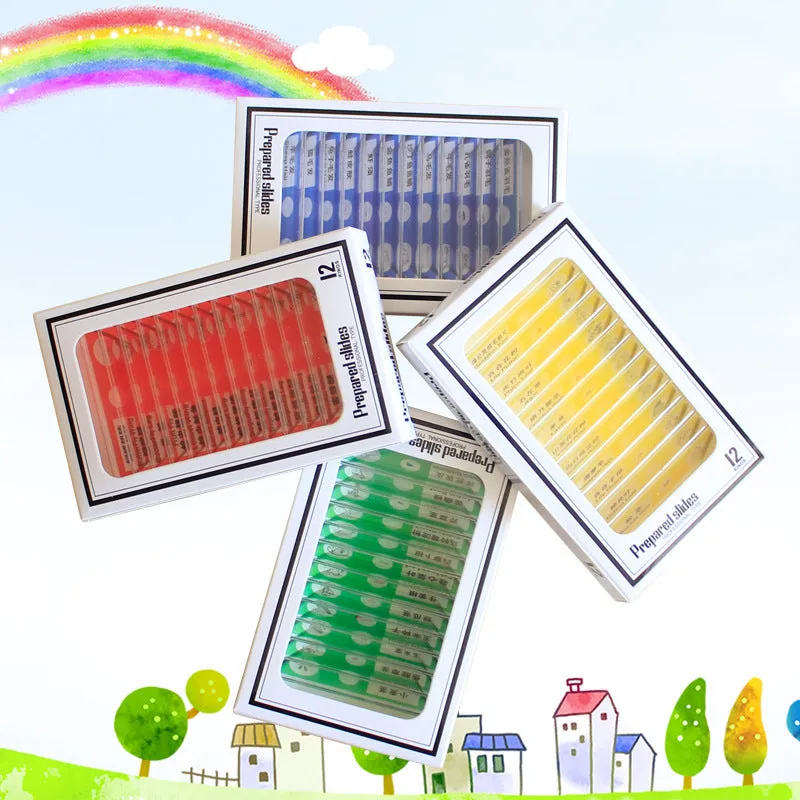
Plastic microscope slides for children's science observation with 48 prepared sections covering plant rhizomes, stems, leaves, flowers, insect wings, and animal hair specimens in four colour-coded categories for educational biology study


Plastic microscope slides for children's science observation with 48 prepared sections covering plant rhizomes, stems, leaves, flowers, insect wings, and animal hair specimens in four colour-coded categories for educational biology study
48 Plastic Microscope Slides for Children's Science Observation with Colour-Coded Biological Specimens

This collection of 48 polystyrene microscope slides provides an organised introduction to biological observation for young science enthusiasts. The prepared specimens are systematically divided into four distinct colour-coded series, each focusing on different biological structures to create a comprehensive foundation for elementary biology education. Rather than requiring users to prepare their own samples, these ready-to-view slides offer immediate access to plant anatomy, insect parts, and animal fibres, making them particularly suitable for classroom settings, home education, or introductory microscopy workshops where preparation time and materials may be limited.
Features and Construction

The slides employ a straightforward organisational system using colour coding to distinguish between specimen types, allowing users to quickly identify and compare different biological structures. This categorisation method supports systematic learning by grouping related specimens together, facilitating comparative observation between similar plant parts or animal fibres without requiring extensive biological knowledge to begin exploration.
Material and Build
The slides are constructed from polystyrene, a durable plastic material commonly used for educational microscopy applications. Each slide contains prepared biological specimens that have undergone a specialised mounting process mentioned in the product information, though the exact nature of this processing and the mounting medium used are not detailed. The polystyrene construction provides sufficient rigidity for handling while offering clear visibility of the mounted specimens, though the specific optical properties and clarity levels are not quantified in the available specifications.
Size and Practical Fit
While exact slide dimensions are not provided in the source text, standard microscope slide measurements typically apply to educational products of this type. The collection of 48 slides represents a substantial quantity for classroom sharing or extended individual study, with the colour-coded organisation helping users quickly locate specific specimen types during observation sessions. The slides are designed to fit standard microscopes used in educational settings, though compatibility with specialised equipment would require verification against specific microscope specifications.
Uses and Placement

These prepared slides serve primarily as educational tools for introducing biological concepts through direct observation. The organised collection allows for structured learning progression, starting with more recognisable plant structures before moving to insect parts and animal fibres. This graduated approach supports curriculum alignment for primary science education while providing tangible examples that complement textbook descriptions of biological structures.
Event or Professional Use
In classroom settings, these slides enable simultaneous observation by multiple students during science lessons, with the quantity supporting group activities and comparative studies. For science workshops or educational events, the prepared specimens eliminate the need for live specimen collection and preparation, allowing immediate focus on observation skills and biological identification. The colour-coded organisation facilitates quick distribution of related specimens for thematic lessons focusing specifically on plant anatomy, insect morphology, or animal adaptations.
Everyday Home Use
For home education or personal exploration, these slides provide accessible entry into microscopy without requiring specialised knowledge of specimen preparation. The variety of specimens supports repeated observation sessions with new discoveries possible even when revisiting the same slides, as different structural details may become apparent with increased magnification or improved observation techniques. The collection's breadth allows family science activities comparing plant and animal structures or tracing biological connections between different organisms.
Benefits and Buying Value

The primary value lies in the ready-prepared nature of these slides, which removes barriers to biological observation that might otherwise require specimen collection, preservation, and mounting expertise. The organisational system through colour coding reduces setup time and helps maintain specimen integrity by keeping similar materials together, while the substantial quantity supports extended exploration across multiple biological domains without immediate need for additional resources.
Reuse and Low Maintenance
The polystyrene construction and prepared mounting should allow for repeated observation sessions with proper handling, though the long-term durability of the mounting under regular use is not specified. Storage in the original packaging or a dedicated slide box would help protect specimens between uses, while avoiding exposure to extreme temperatures or direct sunlight would be prudent given the biological nature of the mounted materials. The slides require no ongoing maintenance beyond careful handling and appropriate storage conditions.
Why Choose This Product
This collection offers practical advantages for introductory biological observation through its organised presentation of diverse specimens and elimination of preparation requirements. The colour-coded system provides immediate organisational benefits for educational settings, while the inclusion of both plant and animal materials supports cross-domain biological learning. For users seeking to begin microscopy without investing in specimen preparation equipment and materials, these ready-made slides provide immediate access to observational science with structured learning support through the categorical organisation.