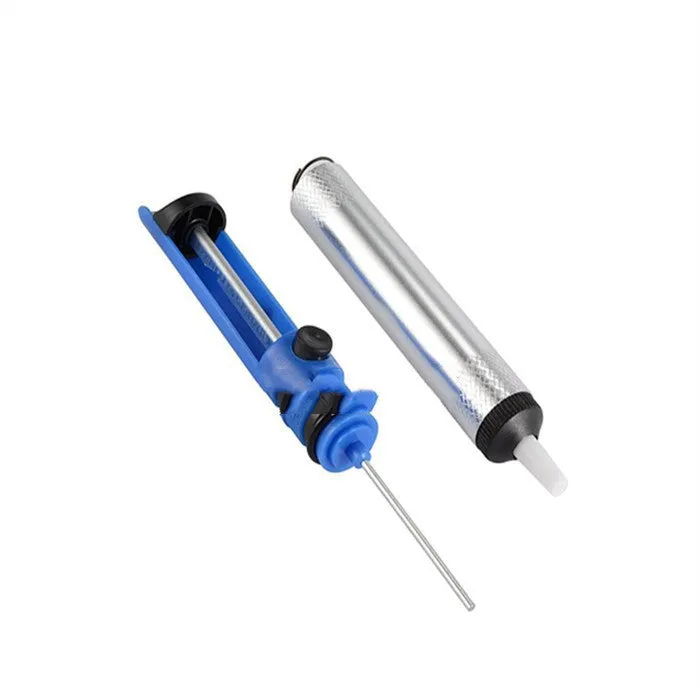
Manual solder sucker device with single large suction pump in blue, gold, or silver colours for efficient tin and solder removal from electronic components and circuit boards.


Manual solder sucker device with single large suction pump in blue, gold, or silver colours for efficient tin and solder removal from electronic components and circuit boards.
GS-107 Manual Solder Sucker for Efficient Tin and Solder Removal from Electronic Components

This manual solder sucker, model GS-107, is a single-unit tool designed for practical desoldering tasks in electronics repair, assembly, and hobbyist projects. Its core function is to efficiently remove molten tin and solder from circuit boards and component leads, facilitating rework and repair without the need for complex, powered desoldering stations. The device is suited for tasks where a simple, manual method of material extraction is sufficient, providing a direct approach to clearing solder joints for component replacement or correction. Its design focuses on a straightforward operation that integrates with standard soldering iron use, making it a relevant tool for workshops, makerspaces, and home electronics enthusiasts.
Features and Construction

The GS-107 solder sucker is built around a manual, single-action suction pump mechanism. Its construction and specifications are tailored to provide a functional, user-controlled method for desoldering, with clear parameters for its use and application.
Material and Build
The main body of the solder sucker is constructed from ABS plastic, a material selected for its combination of durability, lightweight properties, and electrical insulation. This makes the tool safe to handle around live circuits at low voltages when used appropriately. The pump mechanism is integrated into this ABS housing, creating a cohesive unit designed for repeated manual actuation. The construction does not include complex electronics or motors, relying instead on the user's manual force to generate suction, which simplifies maintenance and reduces potential points of failure.
Size and Practical Fit
The tool has an overall length of 330 mm, which provides a comfortable grip and sufficient leverage for effective one-handed operation while also allowing for precise nozzle placement on solder joints. This length balances between being compact enough for detailed work and long enough for a full hand grip. The net weight is 0.1 kg, contributing to its ease of use during extended desoldering sessions by minimising hand fatigue. The physical dimensions are a key factor in the tool's ergonomics and its suitability for the detailed, close-up work typical in electronics rework.
Uses and Placement

The primary application of this manual solder sucker is the removal of tin and solder from electronic assemblies. Its design supports a range of scenarios, from professional repair work to educational and hobbyist projects, where controlled desoldering is required.
Event or Professional Use
In professional electronics repair workshops or manufacturing rework stations, this tool serves as a readily available, low-maintenance option for quick component removal or correcting soldering errors. Its compatibility with a temperature adjustment range of up to 500°C means it can be paired with a wide variety of soldering irons used in professional settings, from basic irons to more advanced temperature-controlled models. The ability to remove solder efficiently aids in reducing turnaround time for repairs, making it a practical tool for technicians who need to perform desoldering as part of a broader workflow without always resorting to bulkier, more expensive equipment.
Everyday Home Use
For electronics hobbyists, makers, or students working on projects at home, this manual solder sucker offers an accessible entry point into desoldering techniques. Its simple, manual operation requires no external power source or complex setup, making it easy to store and use alongside a basic soldering iron. The tool is particularly useful for salvaging components from old circuit boards, modifying existing electronics, or correcting mistakes in new projects. The specified scope of application – the removal of tin and solder – clearly defines its utility in these common, small-scale scenarios where precision and control are often more critical than high-volume throughput.
Benefits and Buying Value

The value of this manual desoldering tool lies in its focused functionality, straightforward operation, and the practical benefits it brings to a user's toolkit. It addresses a specific need within electronics work without unnecessary complexity.
Reuse and Low Maintenance
As a purely mechanical tool with no consumable parts beyond potential nozzle wear, the solder sucker is designed for repeated use over time. Its ABS construction is resistant to the mild thermal exposure encountered during normal use. Maintenance primarily involves keeping the suction channel and nozzle clear of solder debris, which can be done with basic cleaning. This contributes to a long functional lifespan as part of an electronics toolkit, providing ongoing value from a single purchase. The tool's role in facilitating component reuse – by safely removing solder to salvage parts – further extends its value proposition beyond its own durability.
Why Choose This Product
Choosing this manual solder sucker is a decision based on its clear specification match for standard desoldering tasks. The stated maximum suction of 5 cm-Hg indicates its capability to draw molten solder effectively. The 500°C temperature adjustment range compatibility ensures it works with most common soldering irons. Its availability in three distinct colours (blue, gold, and silver) allows for personal preference or tool identification in shared workspaces. As a single-pack product, it represents a complete, ready-to-use solution. For anyone requiring a manual method for tin and solder removal, this tool provides a defined set of features and physical parameters that meet that need directly, without presuming performance beyond its specified scope.